Depth
● ● ● ● ● ● ● ●
Scroll to Fly Forward
Navigation
Swipe or scroll to navigate
System Online: 3D Flight Mode

ZERO
TO
INFINITY

The ultimate comprehensive treatise on black hole physics. Scroll to fly through the cosmos and explore the void.

SCROLL TO DIVE IN
EVENT HORIZON SINGULARITY ERGOSPHERE SPAGHETTIFICATION SCHWARZSCHILD METRIC HAWKING RADIATION INFORMATION PARADOX GRAVITATIONAL WAVES
History BG
MODULE 01

Historical Foundation

The evolution of an impossible idea: from "Dark Stars" to Physical Reality.

Chronological Overview

1783

John Michell

First proposes "dark stars" where escape velocity exceeds the speed of light using Newtonian physics.

1915

General Relativity

Einstein publishes the field equations, linking gravity to spacetime curvature.

1916

Schwarzschild

First exact solution derived. Discovers the "Magic Circle" (Event Horizon) radius.

1939

Oppenheimer-Snyder

Calculates that massive stars can indeed collapse indefinitely into a singularity.

1974

Hawking Radiation

Hawking applies quantum field theory, proving black holes emit radiation and evaporate.

2015

LIGO Detection

First direct detection of gravitational waves from a binary black hole merger.

2019

EHT Image

Humanity captures the first radio image of M87*'s shadow.

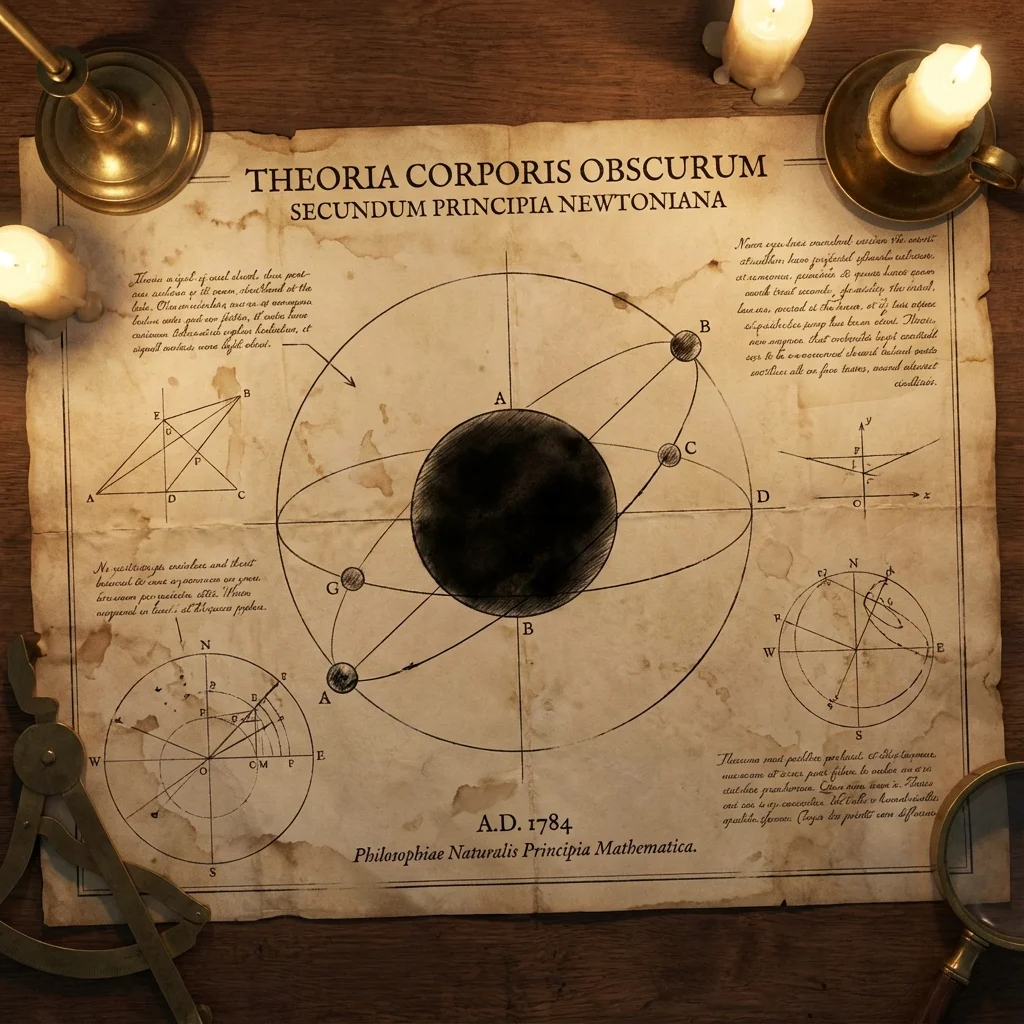
1783: The Corpuscular Theory

Michell's Dark Stars

Long before Einstein, the Reverend John Michell conceived of a body so massive that its escape velocity would exceed the speed of light. Writing to the Royal Society in 1783, he used Newton's corpuscular theory of light—which treated photons as having mass—to argue that light emitted from such a star would be dragged back by its own gravity.

DEEP DIVE: The Newtonian Calculation

Michell's calculation was surprisingly accurate despite the incorrect physical premise (light does not have mass in the Newtonian sense). He equated kinetic energy with gravitational potential energy:

½mv² = GMm/r → v = √(2GM/r)

Setting v = c (speed of light), he found that a star with the same density as the Sun but 500 times the diameter would be invisible. The "corpuscles" of light would shoot up, slow down, stop, and fall back to the surface like a thrown stone. While General Relativity would later discard the idea of light slowing down (c is constant), the radius he calculated is exactly the Schwarzschild radius derived 133 years later.
CONCEPTUAL ACCURACY 45%
Peer
Cavendish
Concept
Escape Velocity
Paper
Phil. Trans.
Successor
Laplace
Michell Diagram
"Light attracted by gravity... made to return towards it."
1915: General Relativity

Einstein's Revolution

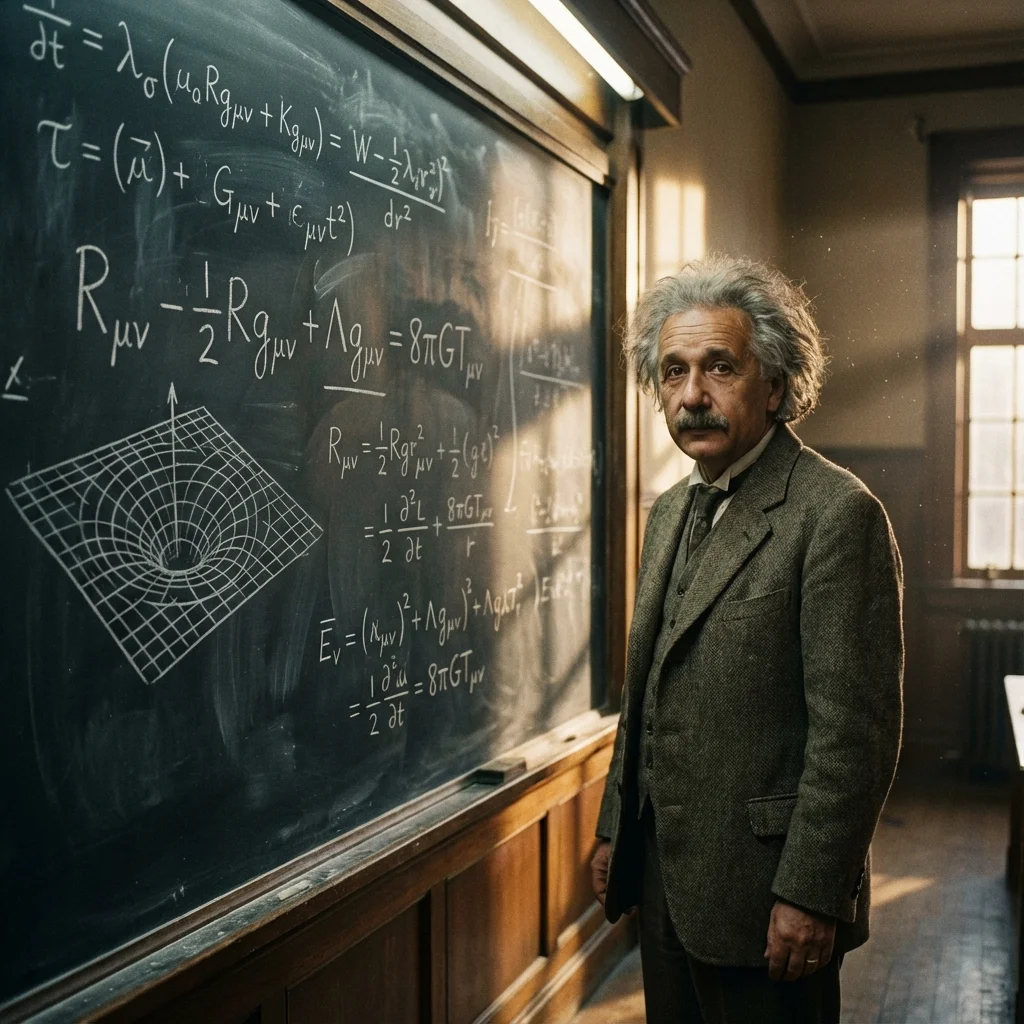
In November 1915, Albert Einstein presented his field equations to the Prussian Academy of Sciences. He dismantled the Newtonian framework of fixed space and absolute time. Instead, he proposed a dynamic, four-dimensional fabric called spacetime, which is warped by the presence of mass and energy. Gravity is not a force, but a geometric feature.

DEEP DIVE: The Field Equations

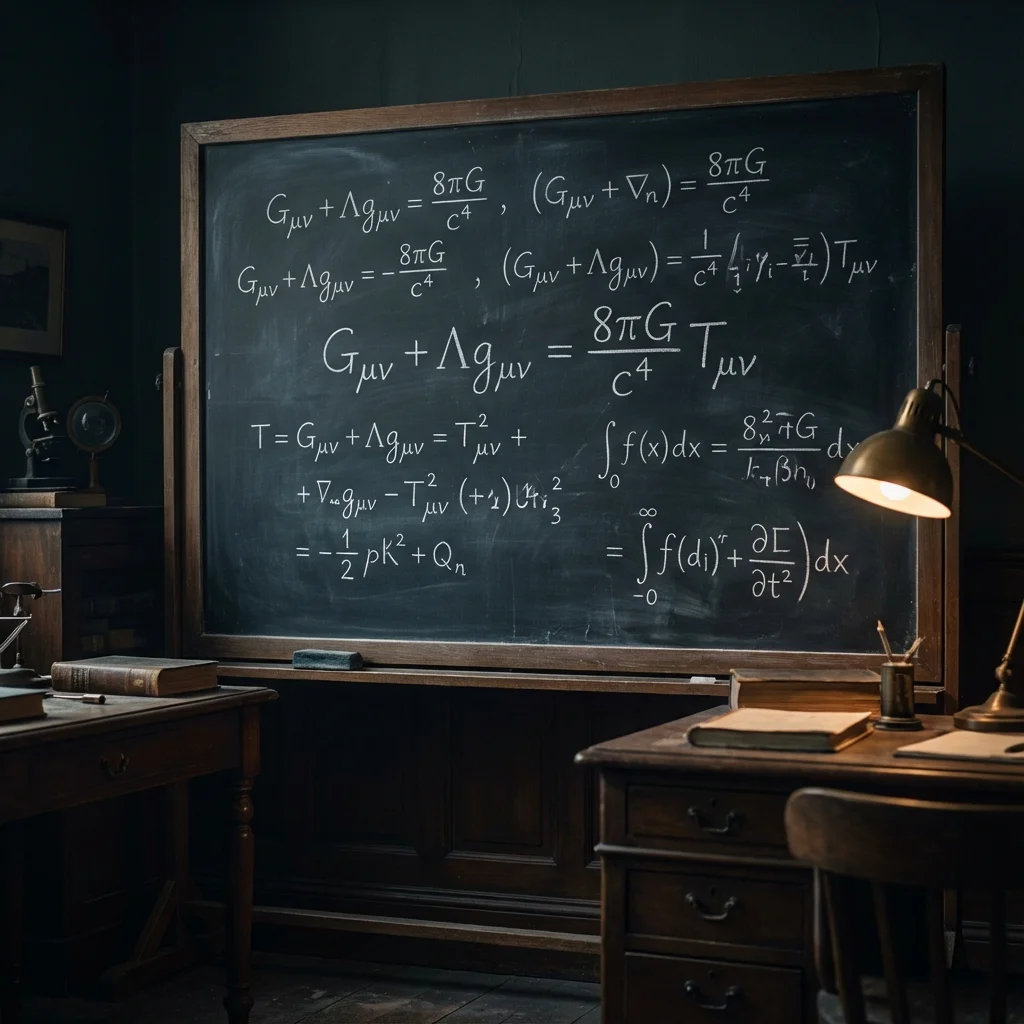
The equation Gμν = 8πTμν is deceptive in its brevity. It represents a system of 10 non-linear partial differential equations.

  • Gμν (Einstein Tensor): Describes the curvature of space and time.
  • Tμν (Stress-Energy Tensor): Describes the density and flux of energy and momentum.

This framework predicted that light follows the curvature of space (geodesics). Near a massive object, these paths bend. If the mass is concentrated enough, the curvature becomes so steep that the geodesics loop back on themselves—trapping light not by pulling it back, but by bending the road it travels on.
THEORY VERIFICATION 99.9%
Key Insight
Equivalence
Tool
Tensors
Rival
Hilbert
Legacy
Spacetime
Einstein
"Matter tells space how to curve. Space tells matter how to move."
1916: The Exact Solution

Schwarzschild's Limit

Serving on the Russian front during WWI, Karl Schwarzschild managed to solve Einstein's equations for a non-rotating spherical mass. He sent the letter to Einstein just months before dying of an autoimmune disease. His solution contained a singularity—a point where the math blew up—surrounded by a spherical boundary now known as the Event Horizon.

DEEP DIVE: The Mathematical Singularity

The metric contains two critical points where the coefficient goes to infinity or zero:

  • r = 0: The physical singularity. Curvature is infinite. Physics breaks down.
  • r = 2GM/c²: The coordinate singularity. Originally thought to be physical, later proven (by Eddington and Finkelstein) to be an illusion of the coordinate system choice. It is a one-way membrane.

This radius is shockingly small. To turn Earth into a black hole, you would need to compress its entire mass into a marble of radius 9mm. For the Sun, it is 3km.

RADIUS COMPRESSION RATIO 1 : 100,000,000
Context
WWI Front
Discovery
Exact Solution
Radius
2GM/c²
Fate
Tragedy
Schwarzschild
"The war treated me kindly enough to allow me this walk in the land of your ideas."
02
Structural Analysis

Anatomy Dashboard

Metric Parameters

Mass (M) Variable
Spin (J) 0 ≤ a ≤ 1
Charge (Q) ~ 0 (Neutral)

Critical Radii

Singularity r = 0
Event Horizon r = 2M
Photon Sphere r = 3M
ISCO (Stable Orbit) r = 6M

No-Hair Theorem

"Black holes have no hair." A stationary black hole is completely described by Mass, Spin, and Charge. All other information (baryon number, lepton number, shape) is radiated away during formation.

M
J
Q
Live Sim Kerr Metric

Interactive Model

The Event Horizon

The point of no return. Here, the escape velocity equals the speed of light. To an outside observer, an object falling in appears to freeze and fade (redshift) forever. To the object, they cross without drama.

Temp
~0 K
Time
Frozen

The Photon Sphere

Located at 1.5Rs (for non-rotating). Here, gravity is so strong that photons are forced into unstable circular orbits. If you stood here, you could see the back of your own head.

Orbit Stability
Highly Unstable

The Ergosphere

Only in rotating (Kerr) black holes. A region outside the horizon where spacetime is dragged along with the rotation (frame-dragging). It is impossible to stand still here.

Penrose Process Energy Extraction Possible

Types of Singularities

Schwarzschild

Point-like singularity. Infinite density, zero volume. The classic result for non-rotating mass.

Ring (Kerr)

A one-dimensional ring due to angular momentum. Theoretically traversable in some math models.

Naked

A singularity without an event horizon. Prohibited by the Cosmic Censorship Hypothesis.

Coordinate

Not a physical singularity, but a flaw in the math (e.g., at the Event Horizon in Schwarzschild coords).

Big Bang

A past singularity. Similar mathematics, but inverted time direction (expansion vs collapse).

Big Crunch

A future singularity. The potential end state of a closed universe collapsing.

Math BG
03
Module Three

Deep Dive: Physics & Math

To truly understand black holes, we must abandon Newtonian intuition. We enter the realm of Differential Geometry, where gravity is the curvature of the spacetime manifold itself. The Schwarzschild metric is the first solution to Einstein's field equations, describing the geometry of spacetime surrounding a spherical mass.

ds² = -(1 - Rs/r)c²dt² + (1 - Rs/r)-1dr² + r²dΩ²
The Schwarzschild Line Element

Glossary of Terms

Concept

Manifold

A topological space that locally resembles Euclidean space near each point.

Math

Geodesic

The shortest path between two points in a curved space. Light follows these.

Object

Metric Tensor

A function that defines distance and angles at every point in spacetime.

Limit

TOV Limit

Tolman-Oppenheimer-Volkoff. Max mass of a neutron star (~2.2M☉) before collapse.

Effect

Frame Dragging

Rotating mass drags spacetime with it. Also known as the Lense-Thirring effect.

Region

ISCO

Innermost Stable Circular Orbit. The closest matter can orbit safely.

Radiation

Bremsstrahlung

"Braking radiation" emitted by decelerating charged particles in the disk.

Structure

Jet

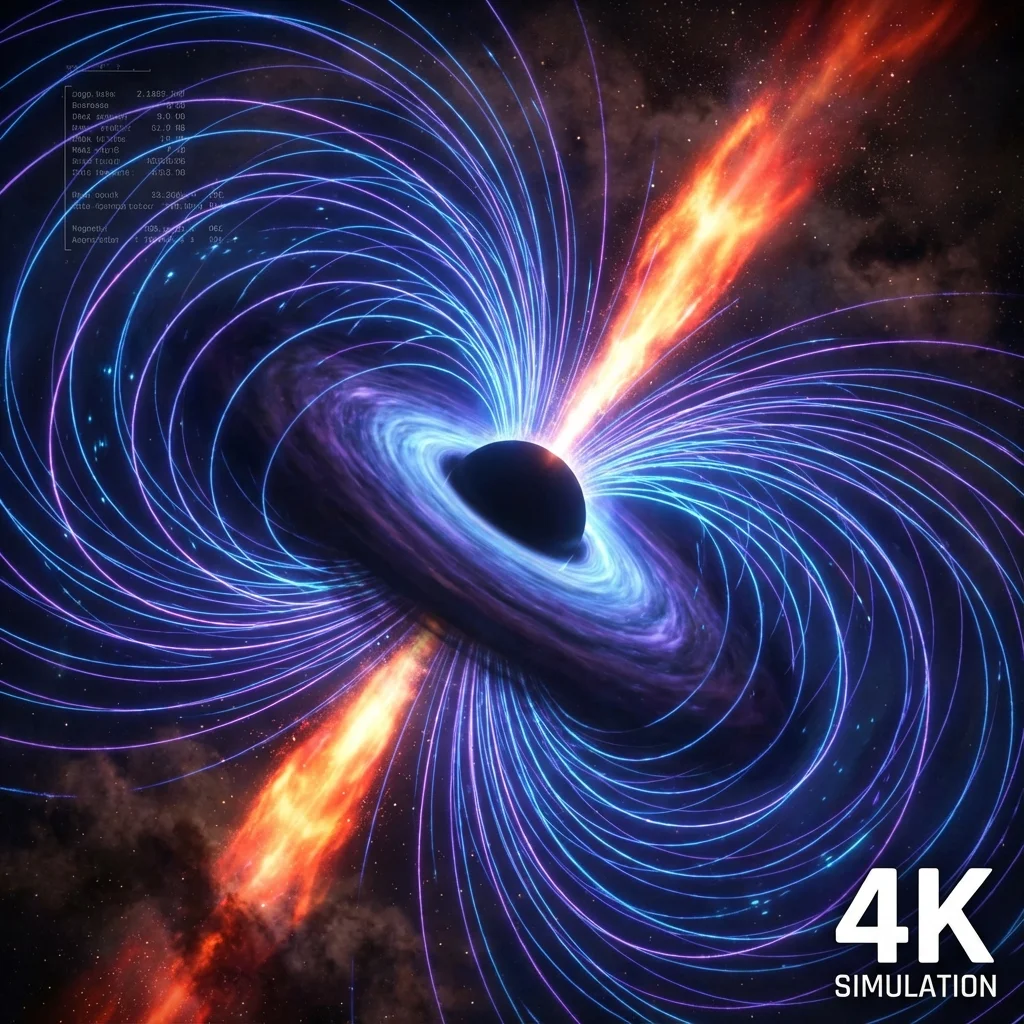
Relativistic beam of matter ejected along the rotation axis.

Phenomenon

Tidal Force

Differential gravity force stretching an object. Source of Spaghettification.

Light

Gravitational Lens

Bending of light from a distant source around a massive object.

Effect

Redshift

Light losing energy as it climbs out of a gravity well, shifting red.

Math

Tensor

Geometric object describing linear relations between vectors/scalars.

Temporal Mechanics

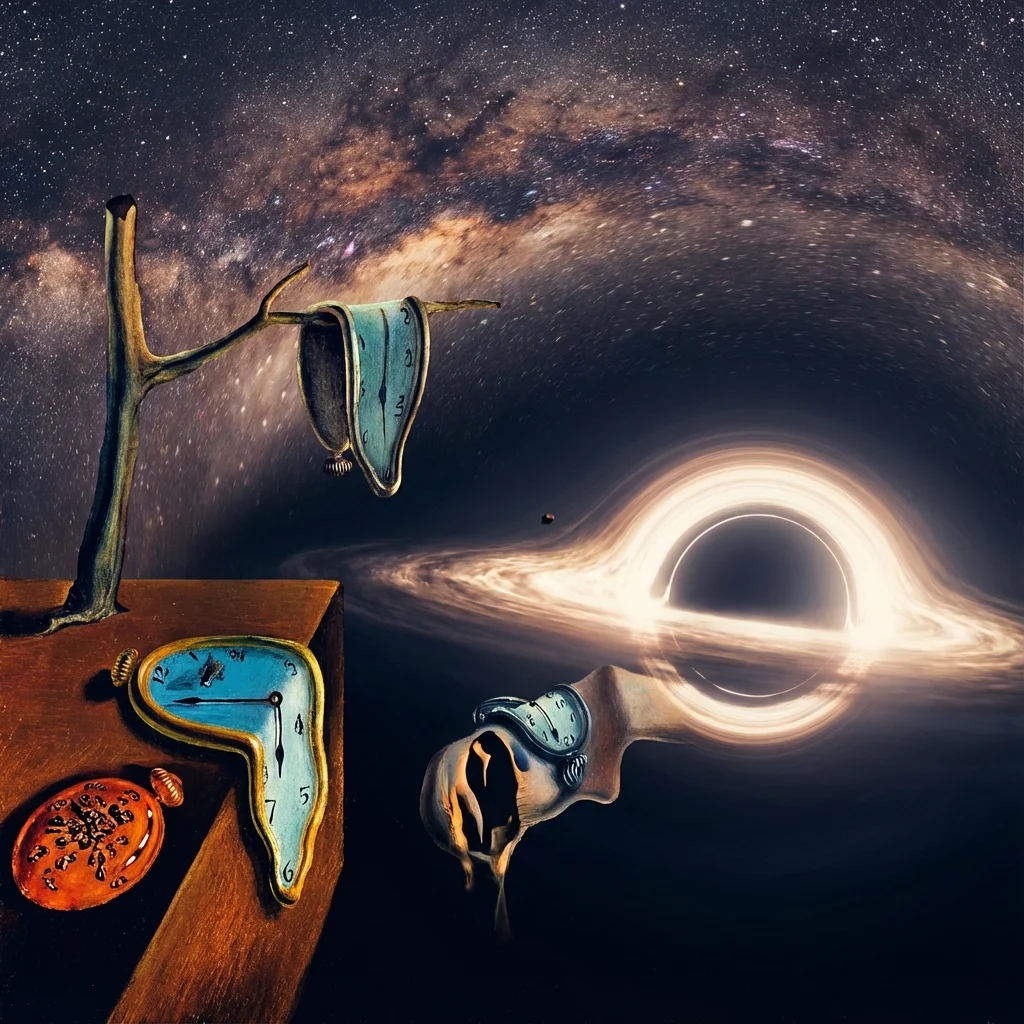
Gravitational Time Dilation

Near a massive body, time itself flows slower relative to a distant observer. This is not an illusion or a mechanical failure of clocks; it is a fundamental property of the universe. The closer you are to the event horizon, the slower you move through time. At the horizon itself, time stands still from the perspective of the outside universe.

DEEP DIVE: The Twin Paradox Extreme

The formula for time dilation near a Schwarzschild black hole is:

t' = t * √(1 - Rs/r)

If you were to hover just outside the event horizon of a supermassive black hole for what felt like one hour, millions of years could pass in the outside universe. This effect allows for one-way time travel into the future. However, the energy required to maintain a stationary position there would be infinite.

TIME RATE AT HORIZON (Relative to Earth) 0%
Film
Interstellar
Concept
Relativity
Test
GPS Satellites
Limit
Infinite
Time Dilation
Tidal Forces

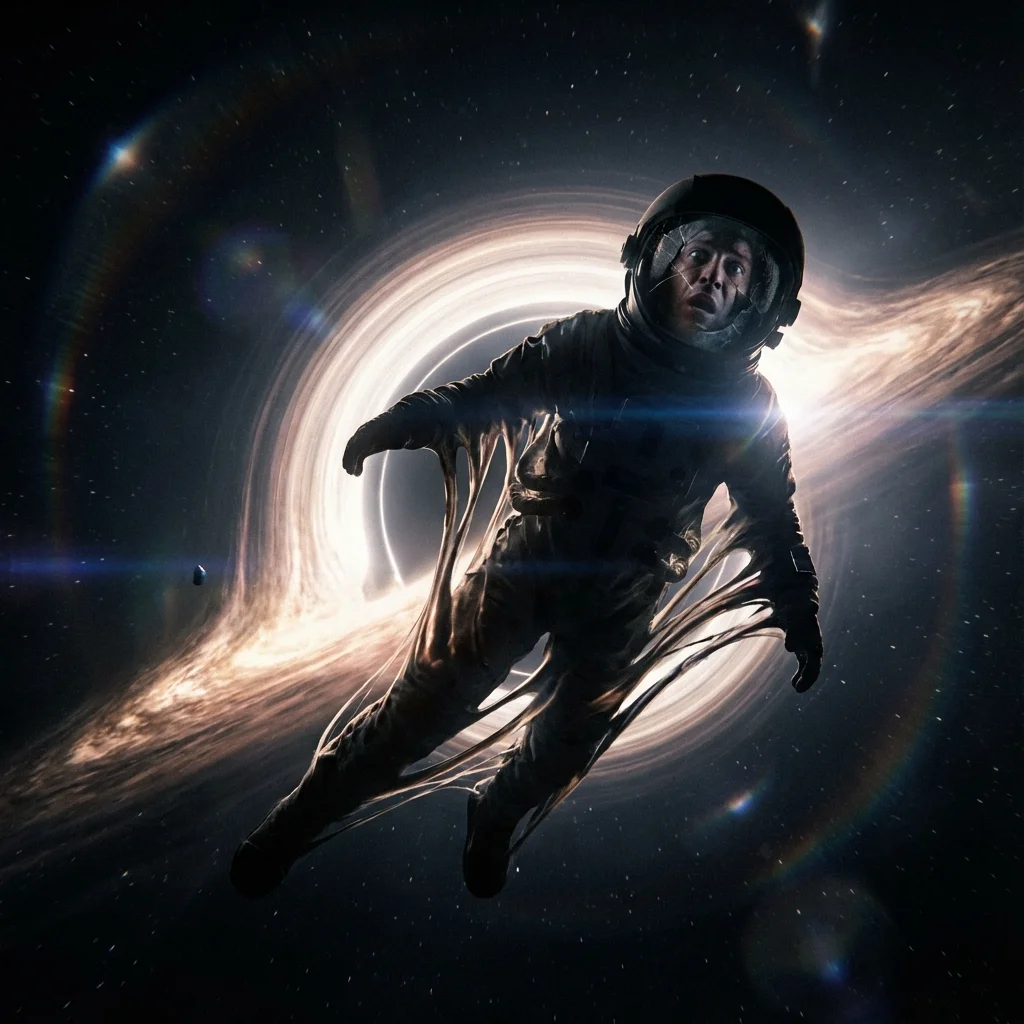
Spaghettification

Technically known as the tidal effect, this is the stretching of an object due to the difference in gravitational force between its head and its feet. In a small black hole, the gradient is so steep that you would be ripped apart into a stream of atoms long before crossing the horizon.

DEEP DIVE: The Tidal Tensor

The tidal force is proportional to M/r³. This means smaller black holes actually have stronger tidal forces at their horizons than supermassive ones.

For a stellar-mass black hole, the tidal force at the horizon is enough to shred steel. For a supermassive black hole like M87*, the horizon is so far away (billions of km) that the tidal forces are negligible at the crossing point. You could cross the event horizon of a supermassive black hole without feeling anything unusual—until you approached the singularity.

STRUCTURAL INTEGRITY (Stellar Mass BH) CRITICAL FAILURE
Term
Hawking
Cause
Gradient
Outcome
Atomization
Geometry
Vertical
Spaghettification
Spectral Shift

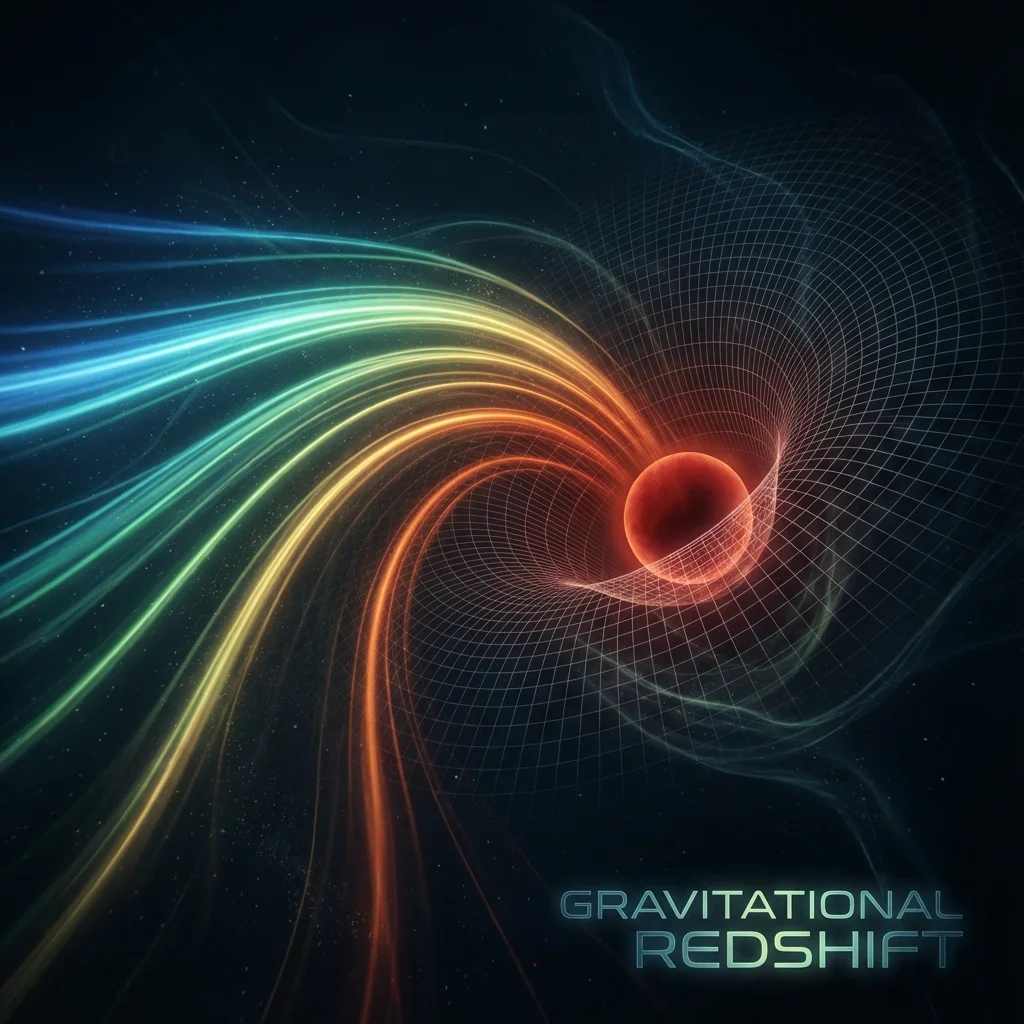
Gravitational Redshift

As light attempts to climb out of the gravitational well of a black hole, it loses energy. Since the speed of light is constant, this loss of energy manifests as a decrease in frequency—a shift towards the red end of the spectrum.

DEEP DIVE: Infinite Redshift

At the event horizon, the redshift becomes infinite. A blue laser pointer shone outward from the horizon would be redshifted so far that its wavelength would exceed the size of the observable universe.

This is why black holes are black. It's not just that light can't escape; it's that any light emitted from just above the horizon is redshifted into invisibility (radio waves and beyond) by the time it reaches us.

WAVELENGTH SHIFT EXPONENTIAL
Exp
Pound-Rebka
Color
Infrared
Energy
Loss
Use
Mapping
Redshift
Formation BG
04
Module Four

Formation & Evolution

Stellar Mass Black Holes

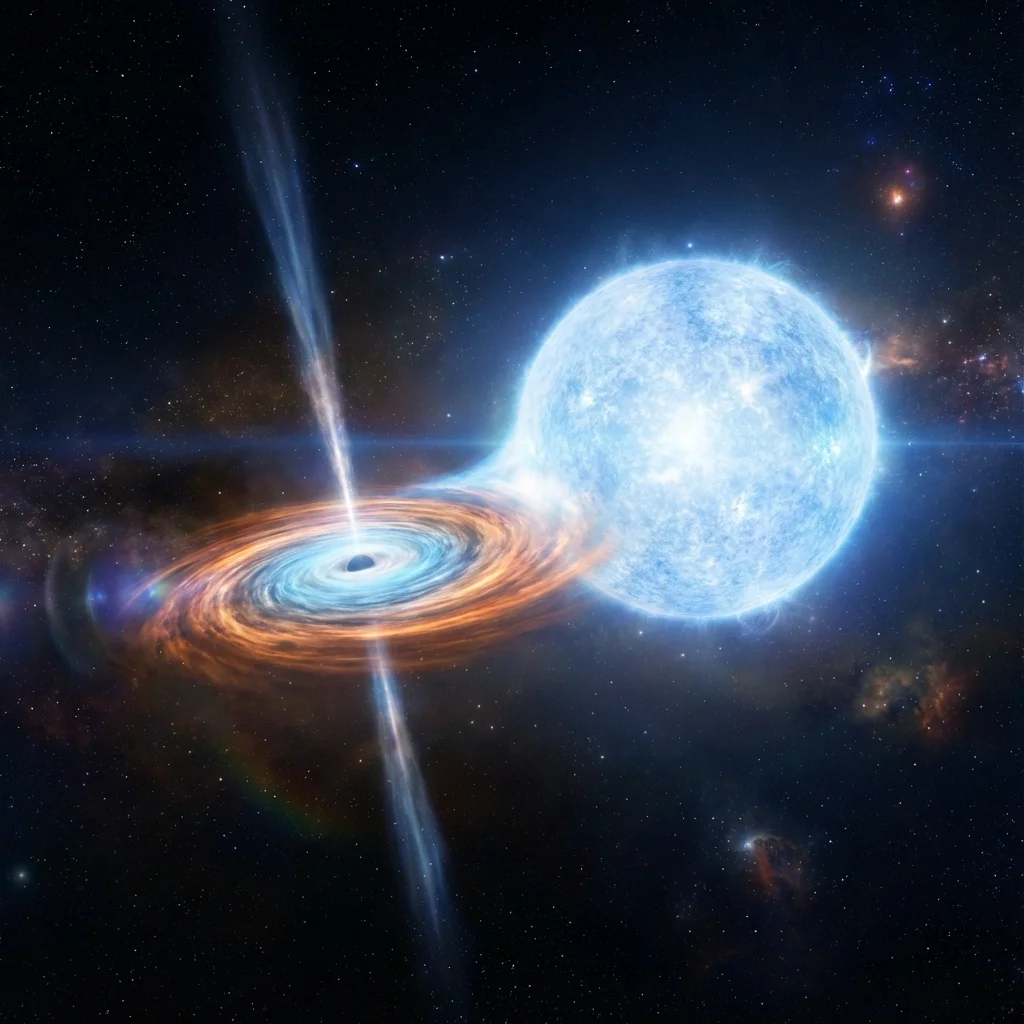
The most common type of black hole forms from the death of massive stars. When a star at least 20 times more massive than our Sun runs out of fuel, thermal pressure can no longer support its weight. The core collapses in a fraction of a second, causing a supernova explosion while the center crushes down into a singularity.

DEEP DIVE: The TOV Limit

The Tolman-Oppenheimer-Volkoff limit defines the maximum mass of a neutron star (approx 2.17 solar masses). If the remnant core exceeds this mass, neutron degeneracy pressure fails, and total collapse is inevitable.

POPULATION ESTIMATE (Milky Way) ~100,000,000
Source
Supernova
Mass
3-100 M☉
Example
Cygnus X-1
Rate
1/Sec
Stellar Mass

Supermassive Black Holes

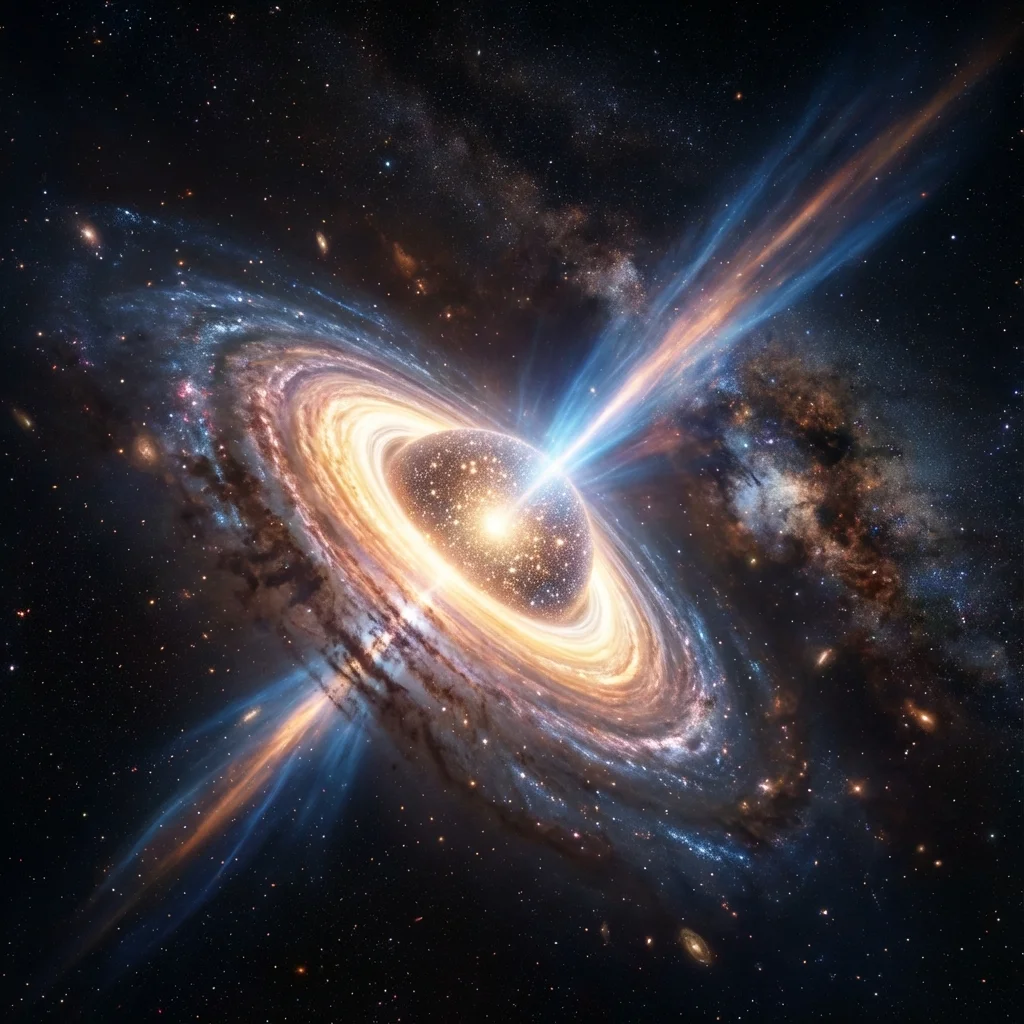
Monsters residing at the centers of nearly all large galaxies. Ranging from millions to billions of solar masses, their origin remains a mystery. They may have formed from the direct collapse of pristine gas clouds in the early universe, or from the rapid merger of smaller seeds.

DEEP DIVE: Quasars & AGNs

When these giants feed, they become Active Galactic Nuclei (AGNs). A Quasar is an AGN so bright it outshines its entire host galaxy. The energy comes from the accretion disk converting mass to energy with up to 40% efficiency (nuclear fusion is only 0.7%).

MAX OBSERVED MASS (TON 618) 66,000,000,000 M☉
Example
Sgr A*
Role
Anchor
Engine
Quasar
Age
Primordial
Supermassive
05
Module Five

Thermodynamics

Hawking Radiation

Classically, black holes are perfect absorbers. Quantum mechanically, they glow. Stephen Hawking showed that particle-antiparticle pairs popping into existence near the horizon can be separated—one falls in, one escapes. The escaping particle becomes radiation, stealing mass from the black hole.

DEEP DIVE: Evaporation Time

Evaporation time is proportional to M³. A solar mass black hole would take 10⁶⁷ years to evaporate. A microscopic black hole would flash out of existence instantly.

T ~ 1/M
Year
1974
Temp
Nano-Kelvin

Bekenstein Entropy

Entropy is a measure of hidden information. Bekenstein realized that if a black hole had no entropy, dropping a tea cup into it would violate the Second Law of Thermodynamics. He proposed the entropy is proportional to the surface area of the horizon.

DEEP DIVE: The Holographic Principle

This realization led to the Holographic Principle: the maximum amount of information held in a volume of space is proportional to the surface area of its boundary, not its volume. The 3D universe might be a projection of 2D data.

Symbol
S
Relation
Area (A)
06
Module Six

Hard Evidence

EHT
2019 / 2022

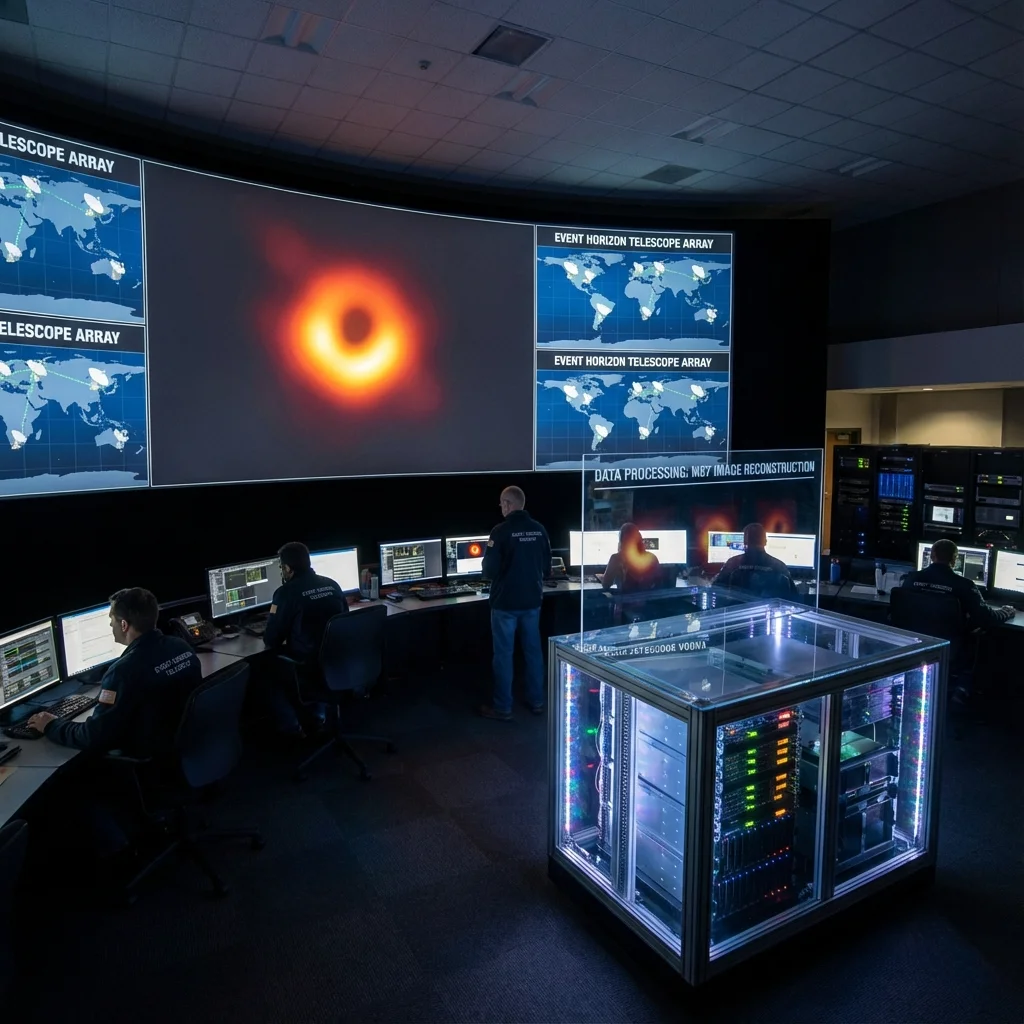
The Event Horizon Telescope

Using Very Long Baseline Interferometry (VLBI), the EHT turned the Earth into a giant eye. It resolved the shadow of M87* (6.5 billion M☉) and Sgr A* (4 million M☉), proving the existence of the photon ring predicted by relativity.

Resolution
20 micro-arcsec
Data
5 Petabytes
LIGO
GW150914

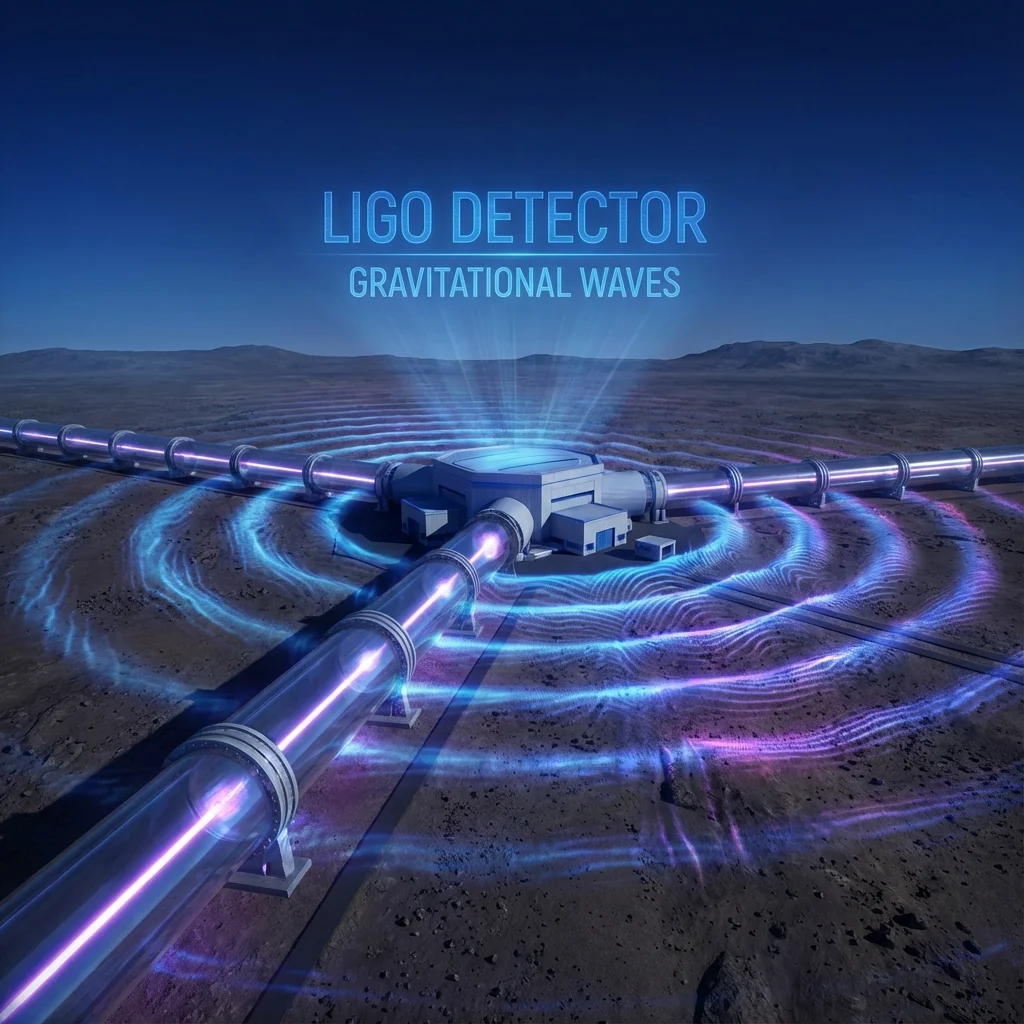
LIGO & Gravitational Waves

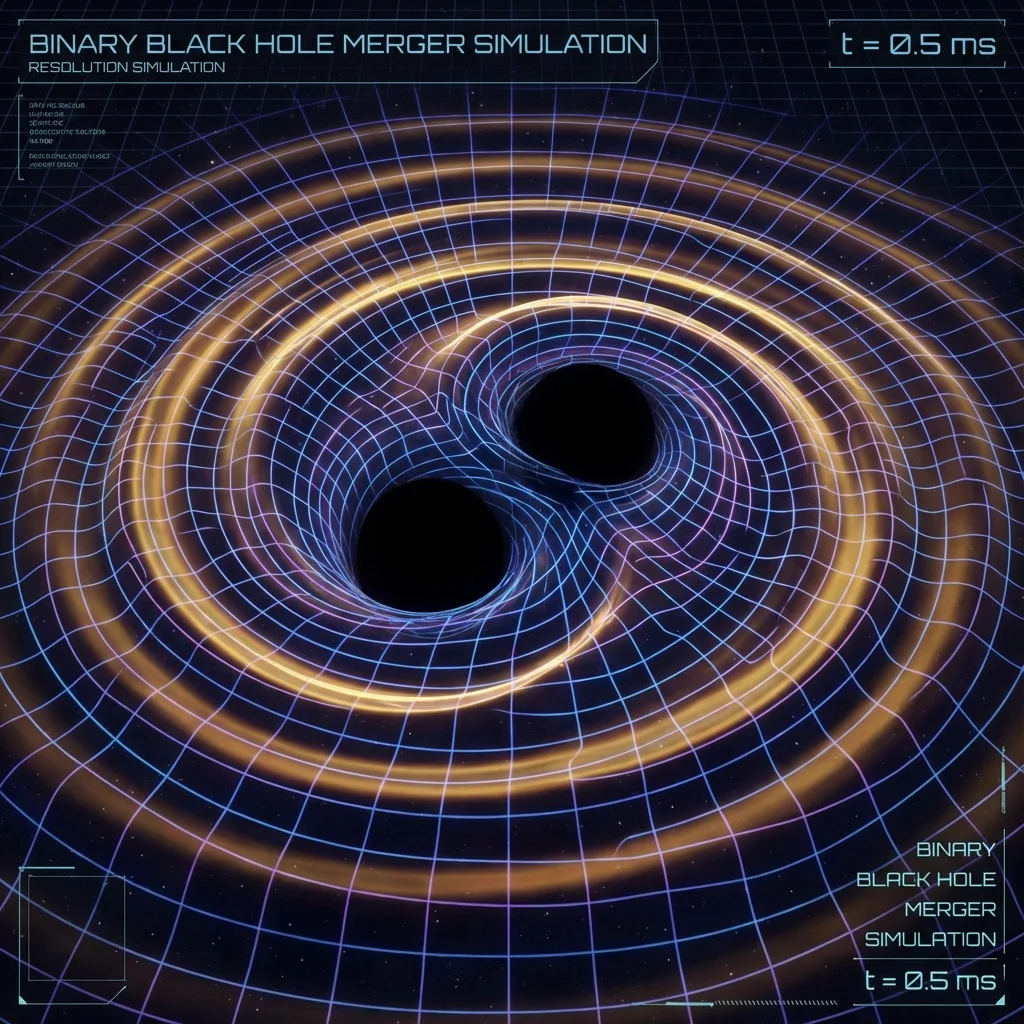
Ripples in the fabric of spacetime caused by the violent merger of black holes. Detected by measuring length changes smaller than a proton using 4km laser arms. It opened a new sense for humanity: we can now "hear" the universe.

Strain Sensitivity
10⁻²¹

Simulation Gallery

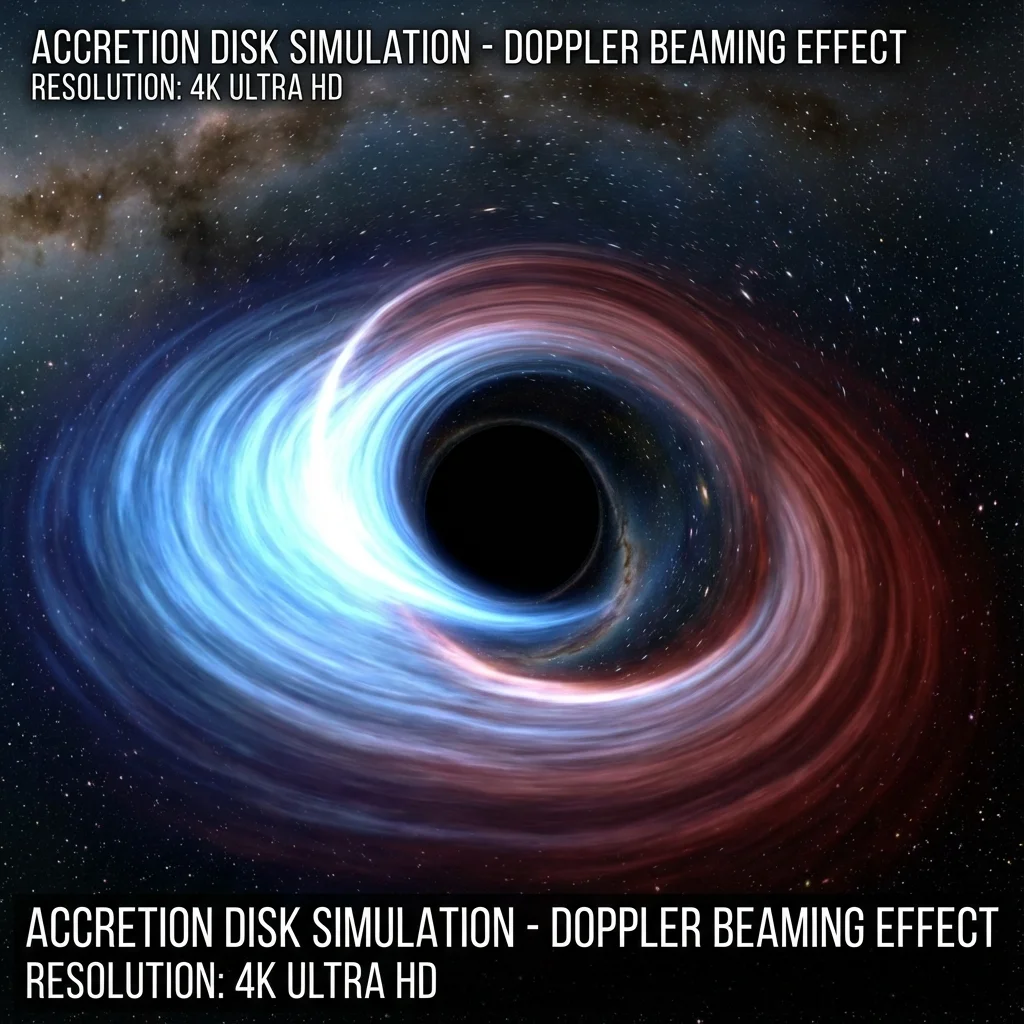
Accretion
Merger
Jet
Photon Ring
07
Module Seven

The Frontier

The Information Paradox

Quantum Mechanics states information is eternal (Unitary). Relativity states black holes evaporate into random thermal radiation, destroying the information of what fell in. These two pillars of physics contradict each other here.

Solution A: Information Loss

Quantum mechanics is wrong. Information is destroyed. (Hawking's original bet)

Solution B: Remnants

Evaporation stops at the Planck scale, leaving a dense nugget of info.

Solution C: Holography/Islands

Information is encoded in the radiation via subtle quantum entanglements.

Firewalls & Wormholes

To save quantum mechanics, some physicists propose a "Firewall" of high-energy particles at the horizon that incinerates anything attempting to enter. Others suggest "ER=EPR", implying that quantum entanglement (EPR) is connected by microscopic wormholes (ER).

Firewall
ER = EPR

Journey Complete

You have traveled through the cosmos to the edge of understanding.